Cart
0
One of the first things that surprises people when they start baking gluten-free bread is the amount of water involved. The dough looks wetter. Softer. Almost suspicious. I’ve seen that look on people’s faces at farmers markets and workshops more times than I can count.
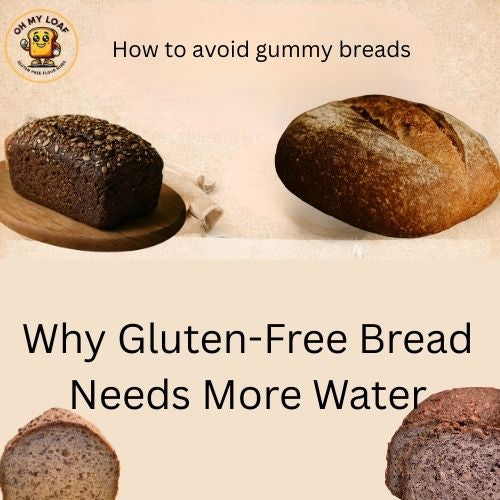
Why Gluten-Free Bread Needs More Water
“Are you sure this isn’t too wet?”
I am very sure. And there’s a good reason for it.
Gluten-free bread needs more water than wheat bread, not because it’s wrong, but because it’s built differently from the ground up.
Once you understand that difference, a lot of common problems like gummy centers, dense loaves, and crumbly slices start to make sense.
Gluten does a job. Water has to replace it.
In wheat bread, gluten is the quiet hero working behind the scenes. When flour and water mix, gluten forms a stretchy network that traps air, holds structure, and gives bread its familiar chew. That network does a lot of heavy lifting with relatively little water.
In gluten-free bread, that network doesn’t exist.
So instead, we rely on hydration + fibers + binders to create structure. Water isn’t just moisture anymore. It becomes part of the architecture of the loaf.
That’s why gluten-free dough often looks wetter than wheat dough. It has to be.
Gluten-free flours absorb water differently
Another big reason gluten-free bread needs more water is the flour itself.
Most gluten-free flours are:
-
higher in fiber
-
more absorbent
-
slower to hydrate
Flours like oat, brown rice, sorghum, millet, and buckwheat don’t absorb water instantly the way wheat does. They need time and enough moisture to fully hydrate.
If they don’t get it, the bread may look fine at first, but the final loaf often turns out:
-
dry
-
dense
-
crumbly
-
or raw inside
That’s not a baking failure. It’s a hydration mismatch.
Why are hydration percentages higher in gluten-free bread
In wheat baking, hydration is often around 60–75%. Gluten-free bread lives in a different world.
In many gluten-free formulas, the ideal amount of water is between 100% and 120% of the total flour weight. Sometimes even more, depending on the blend.
That higher hydration allows:
-
fibers to fully swell
-
binders to activate
-
structure to form evenly
-
heat to travel through the loaf during baking
Without enough water, gluten-free bread doesn’t just dry out. It never fully becomes bread.
Psyllium husk needs water to work properly
One of my favorite structure builders in gluten-free bread is psyllium husk. It creates elasticity, improves sliceability, and helps the loaf hold together.
But psyllium only works when it’s properly hydrated.
That’s why I always recommend using psyllium husk at 5–7% of the total flour weight and mixing it with all of the water first, then adding it to the other ingredients. When psyllium hydrates fully, it forms a gel that acts like a flexible framework inside the dough.
Without enough water, psyllium can’t do its job. Instead of structure, you get stiffness. Instead of elasticity, you get a brick.

Wet dough does not mean gummy bread
This is one of the biggest myths in gluten-free baking.
A wetter dough does not automatically mean gummy bread.
Gummy bread usually comes from:
-
underbaking
-
slicing too early
-
uneven heat
-
or moisture that never had time to redistribute
In fact, many gummy loaves started with too little water, not too much. The outside bakes, the inside can’t finish cooking, and the crumb never sets properly.
Hydration and baking time work together. You need both.
Time matters just as much as water
Water doesn’t act instantly in gluten-free dough. It needs time.
Resting the dough allows:
-
flours to hydrate fully
-
psyllium and fibers to form structure
-
the dough to become more cohesive
And after baking, cooling time matters just as much. Gluten-free bread continues to set as it cools. Slicing too early can trap moisture and create that dreaded gummy texture.
I know waiting is hard. I bake bread for a living and still have to remind myself.
The simplest way to get hydration right
If you’re experimenting with gluten-free bread from scratch, hydration can feel overwhelming. That’s exactly why I created my bread mixtures the way I did.
The Oh My Loaf Starter Pack is designed to remove the guesswork. The hydration is already dialed in, the structure is built into the mix, and the Pullman pan helps the loaf bake evenly from edge to center.
It’s meant to give you a win early, so gluten-free baking feels encouraging instead of exhausting.
You can find the Starter Pack here:
👉 https://ohmyloaf.com/products/starter-pack

A gentle reminder from one baker to another
If your gluten-free bread has been coming out dry, dense, or inconsistent, it doesn’t mean you’re doing something wrong. It often just means the dough needed more water, more time, or a more forgiving formula.
Gluten-free bread asks different questions than wheat bread. Once you answer those questions with hydration, structure, and patience, it starts to behave. 😉
And when it finally slices cleanly and toasts beautifully… that moment never gets old. 🌱🍞
Chef Frank