Cart
0
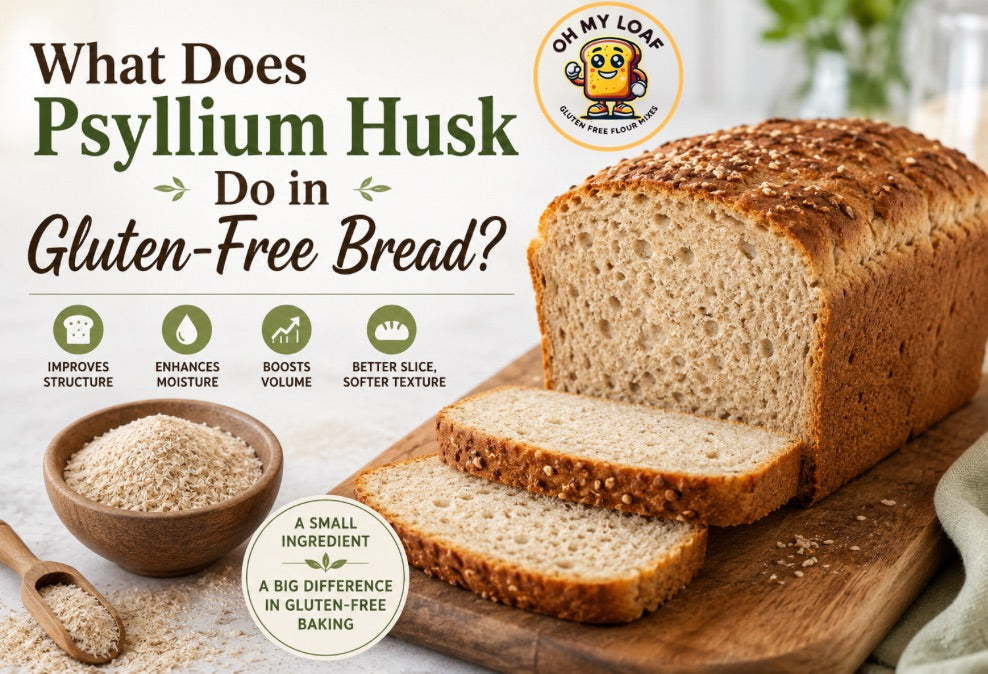
What Does Psyllium Husk Actually Do in Gluten-Free Bread?
If you've spent any time gluten-free baking — or reading our last two posts about gummy centers and crumbly loaves — you've probably noticed one ingredient keeps coming up: psyllium husk.
It shows up in almost every serious gluten-free bread recipe, and for good reason. Here's what it's actually doing in there, in plain English.
The Short Version
Psyllium husk is a ground seed fiber that turns into a gel when it meets water. In gluten-free bread, that gel is standing in for the job gluten normally does — trapping air, holding the crumb together, and giving the dough enough stretch to rise properly instead of collapsing.
No gluten means no natural web to hold everything up, so psyllium builds a substitute one.
Think of it less as a "flavor ingredient" and more as the scaffolding holding the whole loaf up while it bakes.
Why It Works the Way It Does
When psyllium husk absorbs liquid, it swells and forms a thick, sticky gel — almost like a natural glue.
That gel coats the starches and flours in your dough, giving the mixture enough elasticity to trap the air bubbles created by your rising agent instead of letting them collapse or escape.
It's also why gluten-free dough needs to rest for a few minutes after mixing — psyllium needs a little time to fully hydrate and start doing its job before it goes in the oven.
This is also why our gummy-middle and falls-apart troubleshooting posts both come back to psyllium so often — get this one ingredient right, and a surprising number of other problems solve themselves.
How Much Is "Right"?
This is where a lot of home bakers get tripped up. Too little psyllium and the dough can't hold its structure — you'll see it as crumbling, or a loaf that collapses after baking.
Too much, and the texture can turn gummy or overly dense, since the gel doesn't fully set the way you want it to.
Because the effective amount is small relative to the rest of your dry ingredients, even minor measuring differences can shift your results more than you'd expect.
Measuring by weight rather than volume makes a real difference here — a tablespoon of loosely packed psyllium husk and a tablespoon of tightly packed psyllium husk aren't the same amount, and gluten-free bread is sensitive enough to notice.
Ground vs. Whole Husk (They're Not the Same)
Psyllium husk comes in a few forms, and they don't behave identically. Whole husk flakes and finely ground psyllium husk powder absorb water at different rates and can produce different textures, even at the same weight.
If a recipe was developed with one form and you substitute the other without adjusting, that alone can throw off your results — which is part of why recipe swaps don't always translate cleanly between sources.
What to do: Stick with whichever form your recipe or mix was developed for, and if you're building your own blend, pick one form and get familiar with how it behaves before experimenting.
Quick Answers
Is psyllium husk the same as psyllium husk powder? Not quite — powder is more finely ground and tends to hydrate faster and more evenly than whole husk flakes. They can often be used somewhat interchangeably, but expect some difference in texture and hydration timing.
Can I substitute something else for psyllium husk? There are alternatives (like chia gel or ground flaxseed) that provide some binding, but they don't behave identically — psyllium's gelling structure is fairly unique.
If you swap it out, expect to adjust your liquid ratio and possibly your bake time.
Why does my dough feel gluey right after mixing? That's normal — that's the gel forming. It should relax slightly and become more workable after a short rest, which is why most gluten-free recipes build in a resting period before shaping.
Is psyllium husk the reason gluten-free bread needs a rest before baking? Largely, yes. That rest gives the psyllium time to fully absorb liquid and start forming its gel network before the dough hits the oven, which helps the loaf hold its shape as it rises and bakes.
Why We Don't Leave This to Guesswork
Getting the psyllium ratio right is genuinely one of the trickiest parts of gluten-free bread baking to dial in on your own — it's a small-quantity ingredient with an outsized effect on your results.
That's exactly why we built our Starter Kit around it: the psyllium-to-liquid ratio is already worked out, so you can focus on technique and get a feel for how properly hydrated dough should look and behave, before you ever try building a blend from scratch.
Once you've got that reference point, tweaking your own ratios later gets a lot less like guesswork and a lot more like baking.