Cart
0

You slice into your loaf, it looks golden and beautiful, and then — there it is. That dense, slightly wet, gummy band right through the center.
If you've ever wondered whether you did something wrong, take a breath: you didn't. This is probably the single most common thing gluten-free bakers write to us about, and it almost always comes down to one of three fixable things.
Let's get your next loaf right.
Why This Happens in the First Place
Gluten-free bread doesn't have gluten's stretchy structure to hold air and moisture evenly through the loaf, so it leans on other things — usually psyllium husk, careful hydration, and heat — to do that job instead.
When any one of those gets thrown off, moisture gets trapped in the center before it fully sets, and you end up with that gummy layer while the crust looks perfectly done.
The good news: once you know what to look for, it's a pattern you can catch every time.
Fix #1: Your Oven Might Be Lying to You
This is the most common culprit, and almost nobody suspects it first. Most home ovens run anywhere from 15–50°F off from what the dial says. Your crust can hit the right color while the center is still 15–20 degrees short of fully set.
What to do: Grab an inexpensive oven thermometer and check your actual temperature. If your oven runs cool, either bump the set temperature up slightly or extend bake time by 5–10 minutes.
Tenting the loaf loosely with foil partway through lets you keep baking without over-browning the crust.
Fix #2: You're Slicing Too Soon (We Know, It's Hard)
This one hurts to hear, because the smell of fresh bread is basically a dare. But gluten-free loaves keep cooking internally as they cool — the starches are still setting and moisture is still redistributing for a good hour after the loaf leaves the oven.
What to do: Let the loaf cool completely on a wire rack — really, the full hour — before your first slice.
If you want that fresh-bread moment sooner, cut a slice from the end of the loaf rather than the center; the middle needs the most time to finish setting.
Fix #3: Your Psyllium Husk (or Water) Ratio Is Off
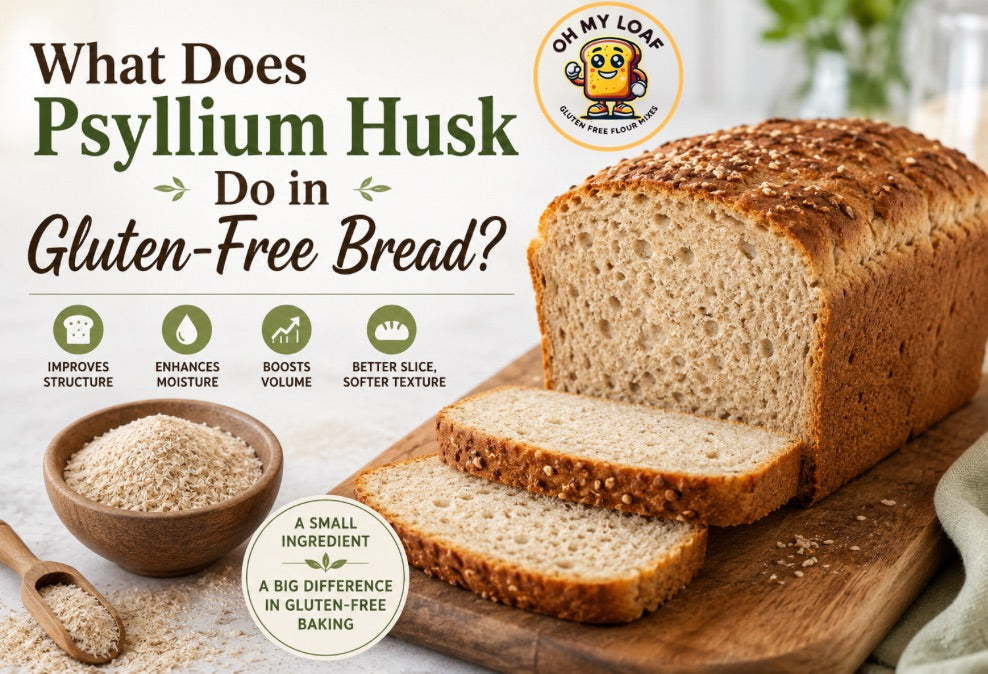
Psyllium husk is doing a lot of heavy lifting in gluten-free bread — it's what gives the dough enough structure to trap air properly instead of collapsing into a dense, wet center.
Too little, and the crumb can't hold itself up. Too much water relative to your dry ingredients has a similar effect, leaving excess moisture with nowhere to go but stuck in the middle.
What to do: Measure by weight if you can, not volume — a kitchen scale removes almost all the guesswork here. If you're using a mix, resist the urge to eyeball the water; small differences add up more in gluten-free baking than in regular bread.
If you're building your own blend and want the ratios already worked out for you, our Starter Kit is set up so the psyllium-to-water balance is done — one less variable to troubleshoot while you're getting your footing.
Quick Answers
Is gummy gluten-free bread safe to eat? Usually yes — it's a texture issue from underset starch, not a food safety issue, as long as the bread was baked to a safe internal temperature.
For bread specifically, you're looking for 208–212°F in the center. (If you're baking a gluten-free cake instead, the target is a bit lower, closer to 205–210°F — cakes don't need to drive off as much moisture.)
An instant-read thermometer in the center is the most reliable check either way.
Will more baking time alone fix it? Sometimes, but not always — if the ratio of wet to dry ingredients is off, extra time in the oven will just dry out the crust before the center catches up.
Check oven temperature and cooling time first; adjust the recipe only if those aren't the issue.
Is there a way to check doneness besides temperature? Yes — weight is a great backup check. A gluten-free loaf should lose about 11–13% of its raw dough weight during baking as moisture bakes off.
If you weigh your dough before it goes in the oven and weigh the finished loaf after cooling, and the loss is well under that range, the center likely hasn't fully set yet — even if your thermometer reading looked borderline. It's a simple way to double-check yourself if you don't fully trust your oven's hot spots.
Does pan size matter? Yes. A pan that's too large for the amount of dough spreads it thin and can throw off both rise and set time.
If your bread consistently comes out gummy despite everything else checking out, it's worth checking your pan dimensions against your recipe's recommendation.
Your Next Loaf
Gummy centers are frustrating, but they're also one of the most fixable gluten-free baking problems out there — it's rarely about skill and almost always about one of these three things.
Check your oven temp, give it the full cool-down, and get your hydration dialed in, and you'll notice the difference on the very next bake.
If you're still working out the kinks, our Starter Kit takes the ratio-guessing out of the equation so you can focus on technique instead of math.
And if this isn't your only gluten-free bread mystery, we've also got a guide on [why gluten-free bread falls apart] and [how to store it] so it stays good past day one.
And if you're the type who likes to nerd out on the why behind ratios like these — hydration percentages, bake weight loss, ingredient function — keep an eye on Gluten-Free Formula Lab, a deeper resource we're building for bakers who want the science alongside the story. It's not live yet, but you can pop your email in there to be the first to know when it opens.
You've got this. Really.